South Azerbaijanis are ethnically Turkic People who mainly live in the north western provinces of Iran. These provinces are East Azerbaijan, West Azerbaijan, Ardebil, and Zanjan. Many Azerbaijanis live in other provinces as well like, Hamadan, Qazvin, Merkezi, Gilan, etc. During the past and current regimes Azerbaijanis were subjected to all kinds of cultural, economical, development and political inequalities and oppression. But what has been the most bitter in the past 90 years has been the central governments’ ambitions to deprive them of their ethnic identity and hence force them to give up and forget the language. If they were to succeed, this would have paved the road to prevent Azerbaijani people from learning their history and naturally, demanding universal rights as a result of their awareness.
After the revolution of 1979 and the overthrowing of the old monarch, in which Azerbaijanis had a vital role, Azerbaijanis started to demand recognition for their long due rights. Not surprisingly, they have been subjected to repressions again and again. Even their simplest demands for linguistic rights, has been regarded as a threat to “national security” and has been met with persecution, jail, torture and even worse.
In these difficult times, the Azerbaijani Movement and its pioneers, the young generation, adopted a symbol. This symbol represented very well the Azerbaijani cause and united them all in their demonstrations against despotism. The Azerbaijanis astonishingly, found this symbol in their forefathers’ distant past of 1500 years ago.
Achina Clan, GokTurks and Wolf Totem
In 439 AD in Central Asia a distinctive clan called “Achina” or “Ashina” lived in the territory now located in north-west china, Xinjiang province or Eastern Turkistan. They spoke either a Turkic or Mongolic language and they were the remnants of the aristocracy of the steppes’ former Xiongnu Empire which had been destroyed by the China Han dynasty in circa 100 AD. Their name, according to the prominent historian “Lev Gumilev” is derived from the Mongolian word for wolf “chono”, “china” or “shina” with a Chinese prefix of “A” which means the respectful, elder, important. In combination it means Noble Wolf or simply “The” Wolf.
During the conflicts between the regional powers Northern Wei and Rouran, these Achina peoples were forced to move north to the Altay Mountains. Since many centuries ago, numerous Turkic tribes lived in and around the Altay Mountains in the vast territories of steppes. Achina clan managed to unite all these tribes under one banner and hence the time of the mighty GokTurk Empire began. GokTurks which means celestial Turks reigned from AD552 to 744. Their territory covered a vast area from Manchuria in the east to the Black Sea in the west. GokTurks and the people of their empire like “Oguz” tribes are the ancestors of most of the modern Turkic People including Azerbaijanis.
The flag of the GokTurks
GokTurk Empire
In 1956, an old Turkic stele was found in Bugut in the Arkhangai aimag of Mongolia. It had inscriptions on all four sides and on the top was a wolf’s image who was nurturing a little boy. It was from the time of the early GokTurk ruler “Taspar (kutluq) Kagan” who ruled from 571 to 582 AD. During this period Turk people were a great empire on the “Silk Road”. The wolf figure on this stele confirms the very old Turkic myth, written in old Chinese annals, that how a she-wolf saved the Turkic Nation from annihilation in the hands of their oppressors. This is a widespread romantic ancient Turkic myth shared among all Turkic People around the world and even adopted by Mongolians in old times.
So goes the myth :
The ancestors of the Turks used to live around the western sea. Turks were attacked by the Lin army and they all have been slaughtered except a ten years old boy. Lin solders found this boy but they did not kill him. They cut his arms and legs and left him to die in a swamp. When the leader of the army heard about this, he ordered them to kill that last Turk too, so their race would be vanished from earth. Meanwhile a she-wolf found the boy and took him to a cave in the distant land of the Altay mountains. There was a vast lowland in the cave and it was surrounded by high grass and pastures. She-wolf breastfed the boy, nourished him and healed his wounds. The boy grew up and mated with the wolf. She, then gave birth to ten sons. They grew up too and married to other girls and therefore Turks got numerous and spread over to the neighboring lands. They built armies and took their forefathers’ revenge from their old foe. They established a state and took control of the lands. In order to respect the memory of their ancestors, Turk Kagans always wave a flag bearing a wolf head in front of their yurts.
Bugut Inscription – GokTurk, 580 AD
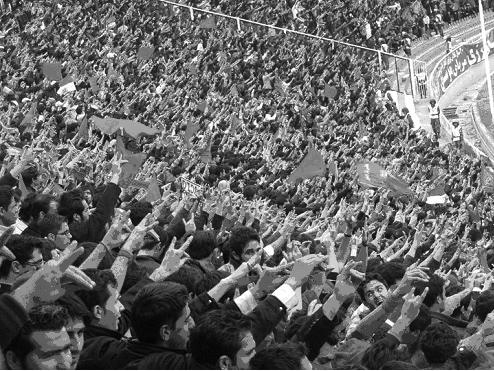
As it is told in this old Myth, Azerbaijani people adopted the Wolf Totem as their saviour to help them regain their identity. They show this reverence to the wolf by forming a wolf head with their hand. They simply say : “I remember who I am”
So is the story behind their symbol, which is an elegant narrative of their ancient Altaic ancestors. May they rest in peace.
Azerbaijanis in Tabriz cheering their favorite football team, Tractor, showing the wolf symbol